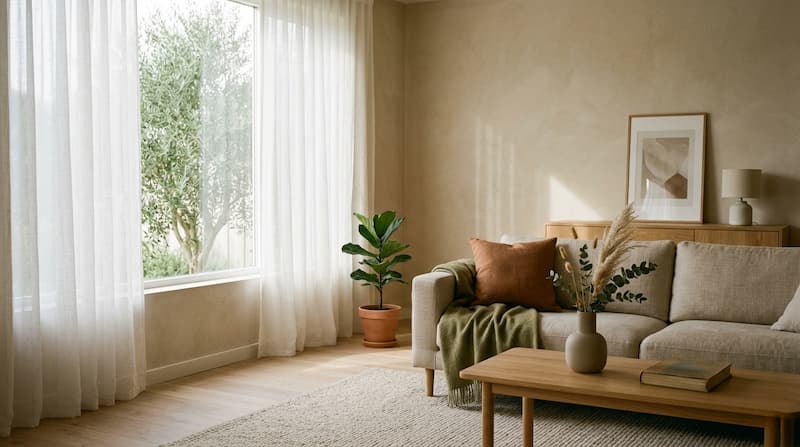
Nobody sat you down and told you that your home was wrong. The algorithm did it quietly, one video at a time, until the sofa you were perfectly happy with started to look like a problem that needed solving.
That’s how it works. You open TikTok for ten minutes. You close it forty-five minutes later with three browser tabs open and a vague but certain feeling that your living room is outdated, your shelves are wrong, and your life would be better with a boucle accent chair.
The feeling is real. The need is manufactured.
The fastest waste stream nobody talks about
Here’s a number worth sitting with: Americans throw away more than 12 million tons of furniture every year. That figure comes from the US Environmental Protection Agency — and it represents a 450% increase from the roughly 2 million tons discarded in 1960. Population growth alone doesn’t explain it. Something else changed.
Of that 12 million tons, 80% goes straight to landfill. Only 0.3% is recovered for recycling.
The reason recycling rates are so low is by design, not accident. Most modern furniture is built from particleboard sealed with chemical glues, wrapped in plastic laminate, and upholstered with materials that can’t be separated at any reasonable cost. A sofa that costs $299 cannot be meaningfully repaired or recycled. It was never meant to be. It was meant to look good in a photo for a season and then go somewhere.
That somewhere is a landfill.
One analysis, drawing on EPA and Bureau of Labor Statistics data, estimated that Americans spend around $8.7 billion annually on trend-driven home decor that gets abandoned within 12 months. The average American spends $1,598 per year on home decor — a figure that has climbed sharply since 2019, with over 60% of purchases directly influenced by social media.
The parallel to fast fashion isn’t a metaphor. It’s the same machine, applied to the room you live in.
A sofa that costs $299 cannot be meaningfully repaired or recycled. It was never meant to be. It was meant to look good in a photo for a season and then go somewhere.
The algorithm that redecorates your house
Design trends used to move slowly. A magazine would feature a look. Architects and designers would interpret it. A watered-down version would eventually reach mainstream retail — often three to five years later. That lag gave people time to decide what they actually liked, rather than what they had just seen.
TikTok collapsed that timeline.
Cottagecore peaked and faded in under 8 months (2020). Coastal Grandmother lasted one summer (2022). Barbiecore was over by September 2023 — just four months after the Barbie film came out. Each of these cycles generated its own purchasing wave: throw pillows, candles, rattan everything, pastel everything, pink everything, then nothing — into a bin bag, into a van, into a hole in the ground.
The algorithm isn’t neutral. It rewards novelty. Content that shows a “before” and an “after” outperforms content that shows a room staying exactly the same, because a room staying the same isn’t content. So the creators optimise for transformation, and the platform rewards them for it, and the viewer is left feeling like their own unchanging room is falling behind.
Research published in ScienceDirect found that the compulsive consumption of content — what researchers now call doomscrolling — is associated with a specific type of anxiety response: a perceived loss of control that leads to reactive, impulsive purchasing as a way of regaining it. You scroll, you feel inadequate, you buy, you feel briefly better, you scroll again.
A 75% buyer’s remorse rate on furniture purchases suggests the relief doesn’t last long.
The algorithm isn't neutral. It rewards novelty. A room staying the same isn't content.
The room that doesn’t need an audience
Here’s what’s interesting about the deinfluencing movement: it grew on the same platform that caused the problem.
The hashtag #deinfluencing has accumulated over 1.5 billion views on TikTok — 582 million of those in a single 12-month window. Creators started telling their audiences not to buy things. Not to trust the haul. Not to redo the shelf. And people responded in massive numbers, which tells you something about how exhausted people already were.
Research from Unilever found that 83% of respondents consider TikTok and Instagram useful sources of guidance on sustainable living, and 75% said social media content had motivated them toward more environmentally positive choices. The infrastructure that accelerated trend culture is now being used to question it.
But the more interesting question isn’t about platforms. It’s about what we were looking for in the first place.
The home has always been a place where people try to express who they are and how they want to live. That instinct is old and real. What changed is that we now have a mechanism — updated hourly, personalised to our specific psychology — that tells us our expression is wrong. Not wrong in any meaningful way. Just behind. Just not the version that’s trending this week.
Personally, I think the most honest design principle is the one that sounds the most boring: buy less, buy better, and stop asking your living room to perform.
The writers and thinkers who have made the strongest arguments for this kind of deliberate living include Jenny Odell, whose book How to Do Nothing argues for reclaiming attention from the systems designed to monetise it, and Carl Honoré, whose In Praise of Slow traces the same logic across consumption, time, and design. Neither of them is writing about sofas specifically. Both of them are writing about exactly this.
The living room is just one room. But it’s the room where this particular argument is playing out most visibly, most expensively, and — given 12 million tons of annual waste — most consequentially.
Your room doesn’t need to be updated. It needs to be lived in.
References
- US Environmental Protection Agency. Advancing sustainable materials management: facts and figures report. Data tables 1960–2018. epa.gov
- Opendoor. 2024 home decor report. Consumer spending survey. opendoor.com
- Recycle Track Systems. Furniture waste — the forgotten waste stream. rts.com
- AweDeco / ABNewswire. Americans waste $8.7 billion annually on social media-driven home decor trends. Analysis drawing on BLS Consumer Expenditure Survey (2022), Opendoor (2024), EPA (1960–2018), Slickdeals/OnePoll (2022–2023), Infegy social dataset (2022–2025). openpr.com — Note: this figure is a third-party estimate, not an independent academic study.
- Shabahang, R. et al. Doomscrolling evokes existential anxiety and fosters pessimism about human nature. ScienceDirect, 2024. sciencedirect.com
- Cummins, E. Fast furniture is an environmental fiasco. The New Republic. newrepublic.com
- Unilever consumer research on social media and sustainable behaviour, cited in AweDeco analysis (2025).
Browse the full list of books about Simple Living